
Indoor CO2 Levels in a Home Office: What a High Reading Means
A CO2 meter turning amber at 1,000 ppm has not caught you crossing a health limit. What the reading says about the air in a home office, where the 1,000 figure came from, what the research on concentration shows, and what to check before you buy a meter.
What to know
- Indoor CO2 is a proxy for ventilation, not a measure of air quality overall. It tells you how much of the room's air has already been breathed, and nothing about radon, gas appliances or solvents.
- ASHRAE says Standard 62.1 "does not provide a limit value for indoor CO2". The 1,000 ppm figure is at best a ventilation-rate indicator, taken out of the standard because people kept misreading it.
- The research disagrees with itself. A 2021 field study of 302 office workers linked each 500 ppm rise to response times 1.4 to 1.8 percent slower; a 2025 chamber study adding pure CO2 up to 2,100 ppm found no adverse effect.
- A plausible explanation: CO2 is an indicator rather than the cause. In real rooms it rises with everything else in stale air, while studies that add CO2 on its own give mixed results.
- A home office can be the least-ventilated room someone occupies all day: offices are ventilated to a code, and a spare bedroom may have nothing but a window and a door.
- If the reading is high, open a window in the room and watch whether it falls; the climb rate with the door closed tells you how often the room needs airing. On a meter, insist on an NDIR sensor; anything labeled "eCO2" estimates CO2 from a VOC reading.
Indoor CO2 is a ventilation gauge, not a toxicity reading, and that changes what to do about a high number. Outdoor air sits around 420 to 430 ppm. A closed room with someone breathing in it climbs from there, and how fast it climbs shows how much fresh air is reaching you. The familiar 1,000 ppm figure was never a health limit: the standards body it is attributed to says so, and dropped the figure from its standard almost thirty years ago.
This is about carbon dioxide in the air of a room. Blood CO2, arterial or venous, and the capnography equipment used to monitor patients are a separate, medical subject, and nothing here transfers to them. If your meter is reading high, the cheapest first step is to open a window in the room you are sitting in and watch the number over the next few minutes. A fall shows that the room was short of fresh air and that the window supplies it; it says nothing about how you feel, only about air exchange.
What the number on your meter is measuring
Indoors, carbon dioxide comes mostly from people. You exhale it, it accumulates, and ventilation carries it away. The concentration in a room is the balance between how much you produce and how much air gets exchanged, which is why it works as a ventilation indicator and not as a pollution reading. In effect it measures how much of the room's air has already been exhaled.
ASHRAE, the US-based standards body behind Standard 62.1, draws the same line. Indoor CO2 is not an overall indicator of indoor air quality (IAQ), but it can be a useful tool if you understand how it relates to IAQ and where its use is limited. One number also does not travel between rooms: no single CO2 concentration applies to every type of space and occupancy when you assess the ventilation rate.
So your meter answers one question: is enough outside air getting in here. That is narrower than the question the display seems to answer, and for a home office it is the more useful one. CO2 says nothing about pollutants that do not come from people: radon, combustion products from a gas stove and the solvents coming out of a new desk are all invisible to it.
Where 1,000 ppm came from, and why it is not a limit
The number is often quoted as though a committee once set it as a safety threshold.
The ASHRAE position document on indoor carbon dioxide, approved in February 2025, puts it directly: "Despite many statements to the contrary, ANSI/ASHRAE Standard 62.1 does not provide a limit value for indoor CO2." The 1,000 ppm figure has long been treated as a marker of acceptable IAQ, but ASHRAE calls it at best an indicator of the outdoor air ventilation rate per person. It was taken out of later editions of the standard because people kept reading it as something it was not, a misunderstanding that ASHRAE says has led to many confusing and erroneous conclusions about IAQ and ventilation in buildings.
NIST's Andrew Persily made the same point at the Indoor Air 2020 conference, in a paper titled Quit blaming ASHRAE Standard 62.1 for 1000 ppm CO2. Standard 62.1, he writes, has not contained an indoor CO2 limit for almost 30 years.
The limits that do exist come from elsewhere, and the occupational ones sit much higher. OSHA's US workplace limit is 5,000 ppm as an eight-hour time-weighted average. Guidelines for the International Space Station and for submarines fall in the 4,000 to 5,000 range. The European standard EN 16798-1 defines four indoor-environment categories at 550, 800 and 1,350 ppm above the outdoor level; those are ventilation and comfort classes, not safety thresholds. These are American and European figures, and other countries set their own.
None of that makes a meter pointless. When one turns amber at 1,000, it is not telling you that you have crossed a line; it is telling you the ventilation in that room is near a level once used as a rough proxy for adequate. That is useful, but not the alarm the color suggests. The same thing happens with the 6500K figure on bias lighting: a number from a standard written for one set of conditions, quoted as if it applied to every room.
What the research shows about CO2 and concentration
Two careful studies point in different directions: one found small associations in real offices, the other found no effect from CO2 on its own.
A field study published in Environmental Research Letters in September 2021 followed 302 office workers in China, India, Mexico, Thailand, the UK and the US, average age 33, measuring CO2 and fine particles in real time. It found small associations. Scaled to each 500 ppm rise in CO2, response times were 1.4 to 1.8 percent slower and throughput 2.1 to 2.4 percent lower, according to the Harvard summary of that work, which describes CO2 there as a proxy for ventilation rather than the direct cause.
A chamber study completed at UCL in 2025 tested CO2 on its own. Sixty-nine participants each sat through 70-minute exposures at 600, 1,500 and 2,100 ppm in a crossover design, with pure CO2 piped in rather than more people added to the room, and took a ten-test cognitive battery. It found no adverse effect. Two of the ten tests showed faster response times at the higher concentrations, accuracy did not change, and grouped by cognitive domain there was no difference between the three conditions. The author concludes that CO2 below 2,100 ppm "could be treated primarily as a proxy for ventilation rates and indoor air quality".
Across the wider literature, ASHRAE counts six studies that found an association around 1,000 ppm and others that found none. The existing evidence "for direct impacts of CO2 on health, well-being, learning outcomes, sleep patterns, and work performance at commonly observed indoor concentrations is inconsistent," it concludes.
The most economical explanation, and this is our reading rather than a finding of either study, is that CO2 is an indicator and not the cause. In real rooms CO2 rises because ventilation is low, and other pollutants rise with it; studies of that kind find small associations. Studies that add CO2 on its own and leave the ventilation alone give mixed results, and the 2025 UCL chamber study is the latest and one of the larger ones to find nothing. Both patterns fit if ventilation is what matters most and CO2 is the part of it that is easiest to measure.
The number still tracks ventilation, which is what it is for. What the evidence does not support is the popular version of the claim, that CO2 itself makes you slower: the associations in the 2021 field study were a couple of percent per 500 ppm, and the chamber study found no effect.
None of this says what a given CO2 concentration does to your body, and the research above has not settled that question either. If you are worried about how a room makes you feel, talk to a doctor; a meter cannot answer that.
Why a home office can be the least-ventilated room in the house
Office buildings are ventilated to a code. A spare bedroom in an existing house may have nothing beyond a window.
A commercial office has mechanical ventilation sized for the number of people expected in it. ASHRAE notes that Standard 62.1's ventilation rates correspond to roughly 1,000 ppm in offices and classrooms, rising past 2,500 in densely occupied spaces such as conference rooms and auditoriums. A spare bedroom was not sized for anything: it has a window and a door, and the door is shut while you are on a call.
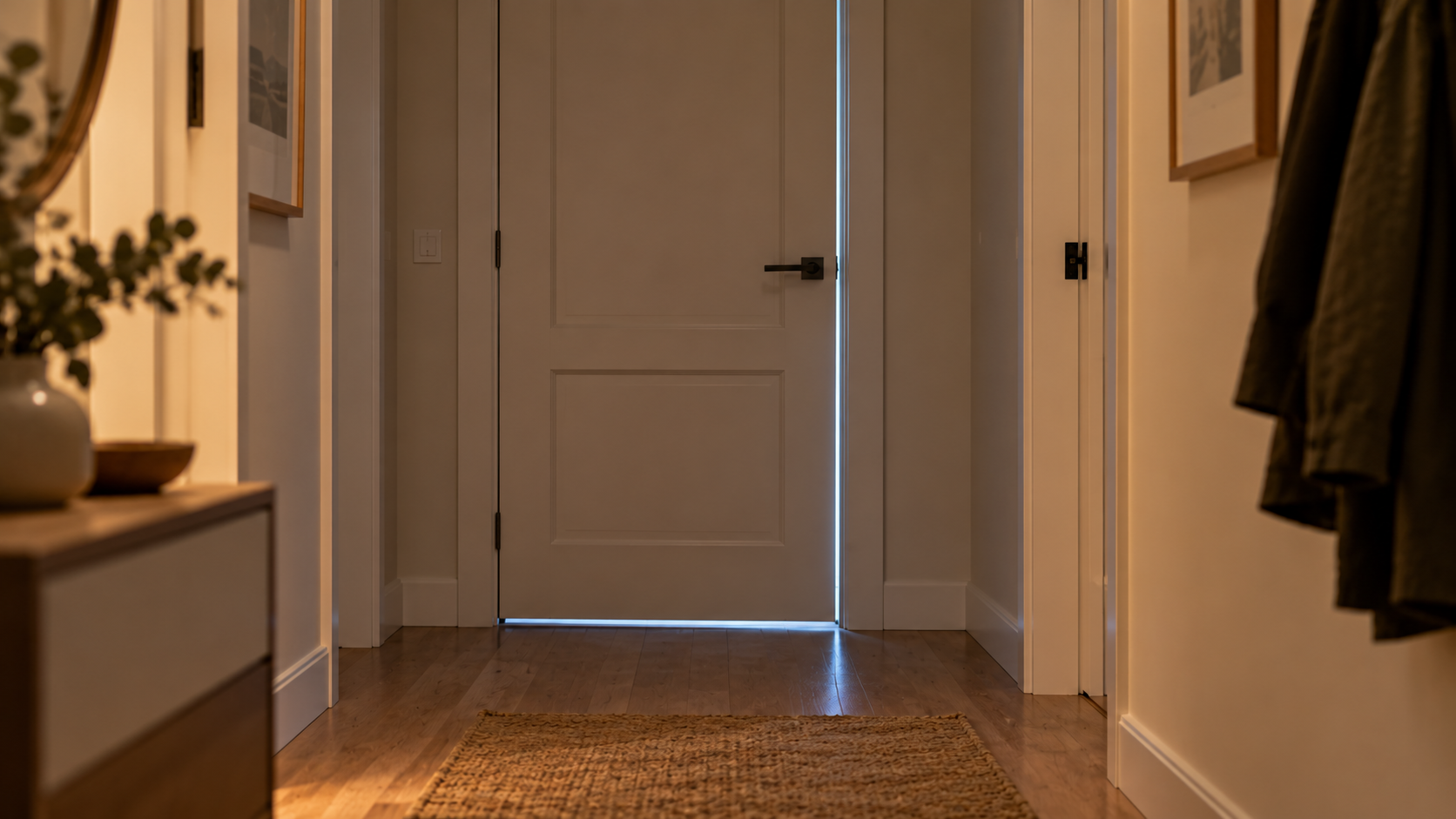
Someone who works from home may spend eight hours in the least-ventilated room in the house. That, rather than any health alarm, is the reason to own a meter.
What to do with a high reading
In the order we would try them, cheapest first.
- Open something. Air exchange is the mechanism, so a window ajar in the room you are sitting in is the most direct fix.
- Open the door. A shut interior door turns a small room into a smaller volume. When you cannot open a window mid-call, an open door gives you the rest of the house to dilute into.
- Find out whether the room has any ventilation at all. A converted bedroom may have a small passive vent at best, while the only extraction in the house is in the kitchen and the bathroom.
- Treat the meter as a timer rather than an alarm. Watch how long the room takes to climb with the door closed. That interval, not any particular number, tells you how often the room needs airing.
The last one is the most useful over time. A single reading is a snapshot; the climb rate is a property of the room, and it stays valid when you are not watching the display.
What we would want from a meter, and what we would ignore
The spec sheet answers the questions that matter before you spend anything, and they matter more than the styling.
Insist on an NDIR sensor. Non-dispersive infrared measures carbon dioxide directly, through how much infrared light at a specific wavelength the air absorbs. It is a measurement rather than an inference.
A spec sheet that says NDIR settles the first question. SAF Tehnika's Aranet4 HOME, for instance, has a true NDIR sensor with a 0 to 9,999 ppm range, a stated accuracy of plus or minus 30 ppm plus 3 percent of the reading, and manual or automatic calibration against fresh outdoor air, by the maker's own figures. Look for the same four items on any candidate: a sensor type, a range, an accuracy figure with a plus-or-minus in it, and a calibration procedure. A meter whose specs give none of the four tells you little about the measurement.
Be careful with anything labeled "eCO2" or "equivalent CO2". That is not a CO2 measurement: an eCO2 figure is derived from a total volatile organic compounds (TVOC) reading. The device reads VOCs with a heated metal-oxide sensor and estimates CO2 from them, on the assumption that people are the main source of both, and its accuracy depends heavily on the algorithm and on the sensor's initial tuning. For a rough trend that is fine. For the number itself it is an estimate, and it is the first thing to check on a cheap multi-sensor device.
Last, look for a calibration function, because NDIR sensors drift over time and the standard correction is to reference them against outdoor air.
Sources
Everything above comes from the standards documents, studies and specifications below, accessed in September 2026. How we research explains the approach.
- ASHRAE, "ASHRAE Position Document on Indoor Carbon Dioxide" (no limit value in Standard 62.1, 1,000 ppm as a ventilation-rate indicator, ventilation rates by space type, the six studies)
- OSHA, "Occupational Chemical Database: Carbon Dioxide" (US workplace limit of 5,000 ppm, eight-hour time-weighted average)
- Andrew K. Persily, NIST, "Quit blaming ASHRAE Standard 62.1 for 1000 ppm CO2" (Indoor Air 2020 conference paper; no CO2 limit in Standard 62.1 for almost 30 years)
- Environmental Research Letters, "Associations between acute exposures to PM2.5 and carbon dioxide indoors and cognitive function in office workers: a multicountry longitudinal prospective observational study" (302 office workers in six countries, average age 33)
- Harvard T.H. Chan School of Public Health, Healthy Buildings, "Impacts of Indoor Air Quality on Cognitive Function" (response-time and throughput figures per 500 ppm)
- Didong Chen, UCL, "An Experimental Study on the Effects of Short-term Exposure to Low-to-medium Pure Carbon Dioxide on University Students' Cognitive Performance" (doctoral thesis; 69 participants, 70-minute exposures at 600, 1,500 and 2,100 ppm)
- Didong Chen, REHVA Journal, "Direct impact of short-term exposure to pure carbon dioxide levels on cognitive performance" (the author's conclusion on CO2 below 2,100 ppm)
- Electronics360, "What are eCO2 sensors?" (how eCO2 is derived from a TVOC reading)
- SAF Tehnika, "Aranet4 HOME" (NDIR sensor, 0 to 9,999 ppm range, accuracy of plus or minus 30 ppm plus 3 percent, calibration)